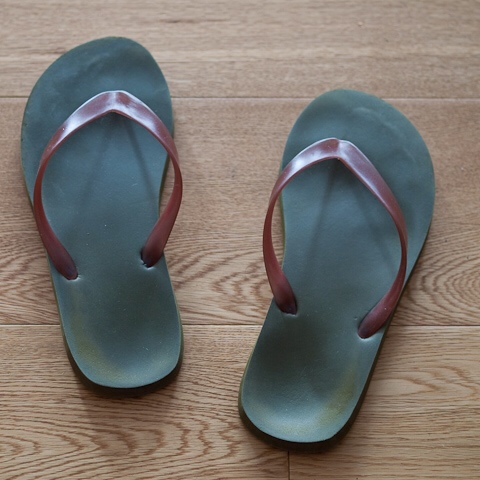
These flop-flops took me up Tian Du Feng

Yes, they did! The Celestial Peak (the commonly-used translation for Tian du Feng) is one of the tallest peaks in Huangshan — the Yellow Mountain in China — reaching 1,810 metres above sea-level. We were there because we’d accepted an invitation to join a group organised by Patrick, who is one of the two brothers of my brother-in-law. I couldn’t find a convincing explanation of how that relationship should be described: brother-in-law-in-law? Brother-in-law once removed?

The 6-night stay (in three different hotels) in Huangshan was to be the highlight of the trip. We’d stopped the night before in a very nice hotel (the Xiangming) in Huangshan City. We were obliged to leave suitcases behind and pack sufficient for the next week in rucksacks, which we would be expected to carry, plus one holdall that would be transported by porter — more on the porters another time. After lunch our coach dropped us off at the cable car, which took us part way up the mountain. The remaining half a km or so was on foot up some pretty steep steps. That should have been a clue about what was to come!

The following day came the trek to Tian Du Feng.

To be honest, I had no idea of what to expect before coming on the trip. I’d been too busy to do much investigation of my own and I figured “how hard could it could be?”. I knew that most of the others in the group (25 in all) would be older than me, some by a considerable margin; so I reckoned that actual rock-climbing would not be on the itinerary and the purchase of proper hiking boots an expensive over-kill. Flip-flops are light, don’t require socks and are easy to dry. I knew from past experience that they’re good at keeping my feet warm in the rain: once feet are wet it only takes few seconds for the water between the foot and the rubber to warm up. I’ve found this to be true even in heavy rain, whereas normal shoes or trainers can become soaked and result in very, very cold feet.

The weather at the start of the journey to Tian Du Feng was not promising, but not actually raining. The first part of the journey was mainly downhill from the top of Yuping Peak (where our hotel was) to a sort of half-way area: a combination viewing platform with a small kiosk and paths further down the mountain as well as being the start of the ascent to Tian Du Feng. We’d seen this as we were coming down the opposite peak:

By the time we reached the kiosk, which you can see in in the bottom-left corner of the picture, it was raining, but not very hard. Gia and I both had jackets (supposed to be waterproof) and we had plastic ponchos that we pinched from the Xiangming in our packs; so we decided to go on. Before too much longer the rain became harder and I decided to leave the camera (I’d taken the Olympus EP-1) in my rucksack so it didn’t get wet, hence, no pictures from the top. You can see a few more shots here — choose Gallery Two>China and you’ll find Climbing Tian Du Feng in the list of albums.

The walk turned into something out of Lord Of The Rings: the “straight stair” followed by the “winding stair”. What you can see in the picture is no more than half the route as the path winds to the left and out of view.

There were a few people coming down the peak; they kept encouraging us that it wasn’t much further. They lied!

I have no idea how long it took, but we eventually reached the top and ritually stood on the bit of rock that proclaimed itself to be 1810m high. The rain was coming down in sheets. But this was not sufficient to dampen the spirit of Chinese enterprise: two men were up there selling drinks (which we didn’t need) and commemorative medallions, which were engraved on the spot:
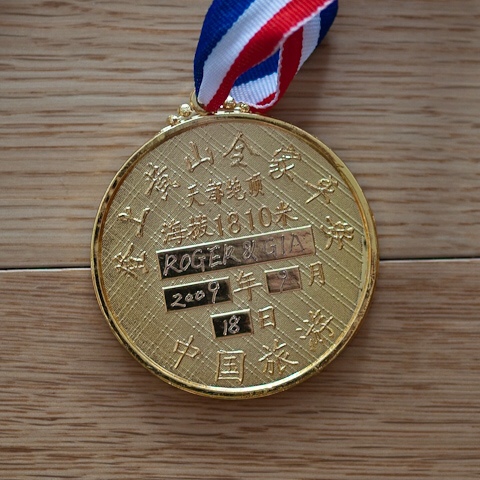
We were cheap and bought one medallion between two.

Rain continued to pour as we made our way down. Water streamed down the steps and we were as wet as drowned rats by the time we reached the halfway house, where I insisted on a beer to celebrate before commencing the climb back up Yuping Peak to our hotel.

Magic with glasses

One of the characteristic things about cruises is the “sea days”. These are the days when the ship does not put into a port. Sometimes you are sailing near the coast and the scenery can attract attention, if not, looking at the sea quickly loses its attraction. So the ship’s entertainment staff provide a range of divertissements to keep the customers satisfied. Quizzes are popular: Charades, Pictionary, Tribond,Name That Tune and, probably favourite, the Trivia Quiz. For some cruisers, the quizzes are a big part of the appeal. This is certainly true for a certain Mr Wolf who is rumoured to spend 200+ days cruising — he was a passenger on our recent Baltic cruise: if Mr Wolf was in the game, there was only one winner.

One of my favourite activities was the wine tasting; there were several different events during the cruise, but the final one was the the most fascinating: The Reidel Wine Workshop. The Riedel family has been in the glass business for 300 years. Claus — 9th generation — realised that the shape of the glass influenced the drinker’s perception of the the drink. Since then the company has been making glasses to suit the wine, or brandy, or port, or grappa or… The Sommeliers range has 38 different glasses.

The Wine Workshop is designed to demonstrate the effect of the glass on the wine. When we arrived in the ship’s dining room, where the workshop was being held, places were prepared with five glasses: four each contained a couple of fingers of wine, the other was empty. The glasses with wine were (I discovered later) from the Riedel Vinum collection; they were the tasting set, which contains one each of the Bordeaux, Montrachet, Burgundy and Sauvignon Blanc glasses. The fifth glass — the “joker” — was one of the water glasses we used at dinner. We weren’t told specifically what the wines were except that they were all Californian — a Sauvignon Blanc, a Chardonnay, a Pinot Noir and a Cabernet Sauvignon/Merlot.

The glasses are gorgeous: 24% lead crystal with different bowl shapes and sizes and varying diameters across the mouth — the rim of which is laser-cut. It’s the interaction of these things that influence our experience of the wine: a larger bowl allows the right wine to “unpack” and develop; a taller glass, tapering slightly inward, contains the more delicate bouquet of certain wines; the size of the mouth (of the glass) directs the wine to different parts of the mouth (of the drinker) — the flow undisturbed by the laser-cut rim. The ping when you tap the glass is beautiful and lasts and lasts and lasts…

There was no food of any kind available during the workshop. We started with the Sauvignon Blanc and the usual wine-tasting performance: sniff the bouquet, swirl the glass, sniff again, then taste. I didn’t take any notes, so I don’t recall the details. It was a perfectly decent SB, more than acceptable. The sommelier leading the session then asked us to pour the remaining wine into the joker glass, and we repeated the tasting. Blecch! Not nice at all! By the time we had finished, we’d tasted all four wines from all five glasses. I was absolutely amazed at the variation. All the wines were fine when drunk from the appropriate glass and were all quite different when drunk from the “wrong” glass — the joker was not necessarily the worst. In one or two of the wine/glass combinations, the immediate impression of the wine was that it was awful.

I am convinced! The glass does make a difference. We were all “given” a set of the glasses after the workshop, which wasn’t free, but the cost represented a significant discount on the retail price; so everyone was happy. I wish now that I’d bought an extra set to be able to run a mini-workshop at home with a wine-loving friend or two. Since coming home, I have tried tasting the same wine in the four glasses and confirmed the effect: the glass does matter; it wasn’t just four carefully chosen wines at the workshop.

There are downsides, of course. The first is price: some of the hand-madeSommeliers range are listed at 90 quid for a single glass. The machine-madeVinum are more reasonable, but still run £15-25 each. Cleaning is another issue. The Vinum are supposed to be dishwasher-safe, but I certainly wouldn’t trust my dishwasher not to damage or stain them. That means (according to the Riedel site) hand-washing: warm water, no detergent, then drying with a linen cloth. For extra shine, steam over boiling water and polish with two linen tea towels — and don’t do it until you’re completely sober. 😊

Still I do plan to add to my small collection: everyone needs the Daiginjo glass.