About You, or Not

Nick Robinson has started work again after a tumour was removed from his lung. So first, I want to wish him good luck for his continuing recovery and treatment.

His post is about the upcoming UK election. He starts:

It’s all about you. Not them. You. …

About you because a general election is one of those rare times when your voice counts as much as anyone else’s.

I think that is total bullshit. I vote. I always vote. I registered for a postal vote because for the last several years of my career I worked outside the UK most of the time. For the last 8 years I have lived in Beckenham. In the 2010 General Election, Beckenham ranked 611 out of 650 for seats with the largest percentage majority—which translates to a majority of 17784 (for the Tories, in case you’re wondering). My vote, whichever way I cast it, is a piss in the ocean.

A 2010 article in The Guardian quotes the Electoral Reform Society:

The Electoral Reform Society contests that, under the current first-past-the-post voting system, over half of the 650 Westminster seats available at the election are considered “safe”. That is, a specific party is likely to be elected, regardless of policies, in 382 constituencies. link

This suggests 268 constituencies were up for grabs. The 268th ranked seat in 2010 was Hexham. The majority was 13.31% of the vote. So roughly 7% of actual voters would need to change their vote to the party coming second—bit if a long shot when you look at figures for seats changing hands. There were big seat swaps in 1997 (184) and 2010 (110), but in the 15 other elections back to 1950, no other election had more than 89 changes, and there were only another four over 50.

fivethirtyeight.com has this to say about marginal seats:

The battleground of a political election are the so-called marginal seats. These are the places where only a few percentage points stand between the front-runners and their competition, so the seat could easily “fall” or change hands. Voters in these seats are known as “floating” or “swing” voters. In 2010, there were 194 seats where the swing (i.e., the fraction of votes needed for the outcome to have been different) was 5 percentage points or less. Based on current polling, it looks like this election will also be a close fight in many parts of the U.K. (to be more precise, in 102 constituencies, there are 5 percentage points or less between the two leading parties).

So it looks likely that the election will be decided by voters in between 50 and 100 constituencies. Nick writes:

If you live in a seat where the outcome’s in doubt, you could make the difference between who wins and loses.

Yes, yes. Tell us something we didn’t know. It’s his next sentence that really pisses me off:

Even if you live somewhere where the same party always wins, your vote could send a signal about the national mood.

It might send a signal, but I’m pretty sure that no bugger will be listening.
Delusions


If you want proof that belief in Christ can make people delusional, just watch this daft video.

Here’s an interesting quote from Wikipedia:

Importantly, research on action priming has shown that subliminal stimuli can trigger only those actions that one plans to perform anyway: an action can be triggered subliminally only if the person already has the specific intention to perform this specific action.

H/T Skeptic Ink

More Reasons To Feel Old

I have just started reading Becoming Steve Jobs by Brent Schlender and Rick TetzeIi. This early section made me feel very old. Clearly, the authors deemed it necessary to explain in very simple terms what mainframes and punched cards are.

After settling on the problem you wanted the machine to solve, you would painstakingly write down, in a programming language like COBOL or Fortran, a series of line-by-line, step-by-step instructions, for the exact, logical process of the calculation or the analytical chore. Then, at a noisy mechanical console, you would type each individual line of the handwritten program onto to its own rectangular “punch card”, which was perforated in such a way that the computer could “read” it. After meticulously making sure the typed cards were in the right order—simple programs might require a few dozen cards that could be held by a rubber band, while elaborate programs could require reams that would have to be stacked carefully in a cardboard box. You would then hand the bundle to a computer “operator”, who would put your deck in the queue behind dozens of others to be fed into mainframe. Eventually, the machine would spit out your results on broad sheets of green-and-white striped accordion-folded paper. More often than not, you would have to tweak your program three, four, or even dozens of time to get the results you were looking for.

Clearly, the authors expected that most of the readers would have no clue about this era of computer use. I’m not sure, though, why they deemed it necessary to put so many “words” in quotation marks. And the authors either never used punched cards themselves, or they have forgotten that a successful run by no means meant you got “the results you were looking for”.

There’s been a certain amount of broohaha about the new book with some complaining of hagiography, but people close to Steve Jobs, like Tim Cook and Jony Ive, claim it gives a more balanced and realistic view of the man they knew than the [official biography][4] by Walter Isaacson. Here’s John Gruber’s take on the issues with the Isaacson book and his response to negative criticism of Becoming Steve Jobs.

Being skeptical about UKIP and their claims

UKIP have dangerous, science denialist policies and approaches. They are almost entirely funded by the banking and corporatist elite whilst being in bed with notably infamous organisations both in Europe and the US.

via Being skeptical about UKIP and their claims; Are they racist? Libertarian? Rational? | A Tippling Philosopher.


What’s the point of fact checking?

The underlying idea is that bad information, whether maliciously or innocently entered into the debate, can be corrected with good information. In an active and vigorous political culture, lies will be punished and truth will rise to the top.

via What’s the point of fact checking? — Medium.

Unfortunately, this idea is apparently pants. Ergo, Fox News.

10 Secrets The Catholic Church Hopes You’ve Forgotten

10 Secrets The Catholic Church Hopes You’ve Forgotten – Listverse.

This is not pleasant reading. The dreadful Mother Teresa is only number 10.

H/T: Debunking Christianity.


Random Acts of Kindness

Now the tough part – don’t do the random act of kindness in a non-random fashion. In other words, don’t go out with the intent on doing an act of kindness. Just go out into the world and if you see someone who could use some help and you can give that help, do so. Then do that all the time. That’s called being an awesome person.

via Random Acts of Kindness – Dangerous Talk.

Terry Pratchett

Terry Pratchett

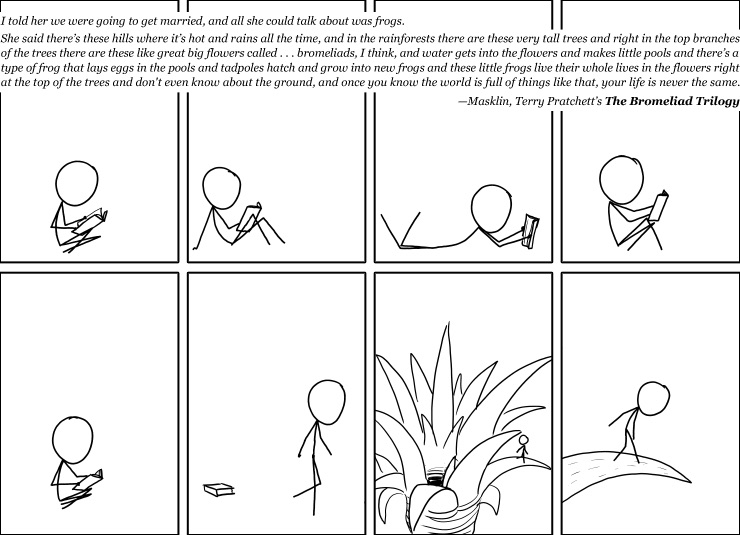
From xkcd.

The kind of humour that I think Sir Terry would have enjoyed.

Jesus and Mo nail it again

Jesus and Mo.

What a bunch of wankers are the IHRC!

Gene Duplication May Be the Cause of Human Brains

It is very likely that a total accident is one of the reasons humans evolved into intelligent creatures.

via Gene Duplication May Be the Cause of Human Brains | Smilodon’s Retreat.

Puzzle