Marvellous Champagne

More on the delights and benefits of Champagne from Your Good Health!: Medicinal Benefits of Wine Drinking by Dr Maury:

You would do better to choose… (as an appetiser)… extra-dry Champagne which is heartily recommended for several reasons… this wine has a beneficial effect on the alimentary canal through its natural aeration. This acts on the stomach muscles which thus retain their suppleness and elasticity. (p 55)

I have already commented that the wines from the Champagne region, whether dry or extra-dry, have a beneficial effect, both chemical and mechanical, on the digestive system. They are therefore recommended for people suffering from flatulence and a bloated stomach. (pp 57-58)

… you should bear in mind the complications associated with this condition: arterial hypertension, the risk of narrowing of the coronary arteries and the possibility of a heart attack… your diet should be complemented by natural elements designed to strengthen the action of the heart and improve kidney function. You should therefore include the wines of the Champagne region, the extra-dry Champagnes of the Montagne de Reims, Côtes des Blancs or those of the Marne valley. (p 66)

… the sulphuric anions in Champagne wines activate the mechanisms of cellular oxidisation and give them purifying and cleansing properties. Finally, as dry white wines they possess powerful diuretic agents, helping to rid the body of its wastes. (p 66)

People who have mild rheumatism should opt, depending on personal taste, … for the ‘blancs de blancs’… of the Champagne region… (p 76)

Still with the same aim of restoring organic and functional order, never forget the beneficial effects of extra-dry Champagne, due to its natural phosphorus content. Its glucose and fructose content also helps to restore energy. (p 85)

On the other hand, if the mineral deficiencies are phosphatic salts, causing physical fatigue and mental depression, the Champagne wines are very suitable… They have the added bonus of ascorbic acid (vitamin C). The most noble of all, an extra-dry variety, should be chosen and two glasses may be taken as an apéritif. (p 91)

The good doctor recommends Champagne (usually extra-dry) for loss of appetite, cardiac problems, digestive ailments, rheumatoid arthritis, convalescence, detoxification, mineral deficiencies, hypertension and heart attack.

One final quote:

This spirit of creativity, drawn from the ‘divine nectar’ is evidence of an art of living and a joy in living. If it is sometimes hidden, it will always surface in those millions of bubbles that rise from a glass of Champagne. It took a man dedicated to God, Dom Pierre Pérignon, cellarer of the Abbey of Hautvilliers in the Marne district, inspired by the pagan influence of Bacchus, to blend the vintages of different varieties of wine. By this act of creation was born a beverage of incomparable quality, which can only be produced in the soil of Champagne. It does not need us to exalt its virtues and describe how it affects the emotional centres of the brain by arousing the noble functions of the spirit. (p 100)
 

Wine is the best medicine

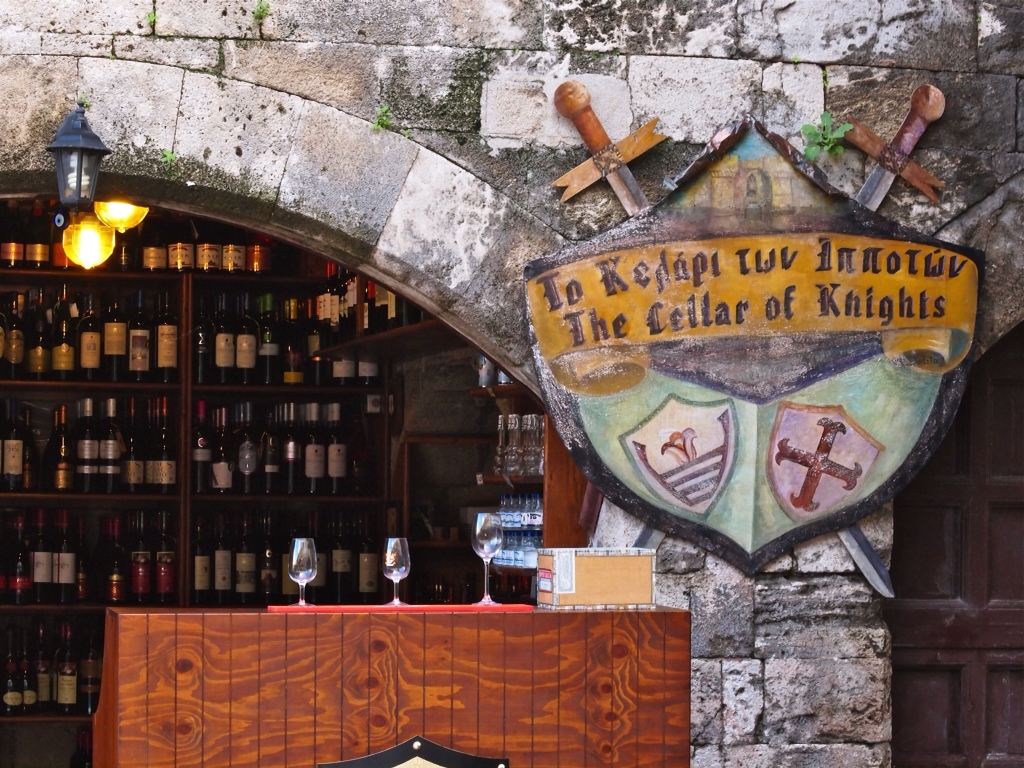
Wine Shop in Rhodes


“… a meal washed down with water, even if it is served in a crystal carafe, is an unfortunate error in taste and a grave dietary error, as it is one of the causes of dyspepsia. Relying on this tasteless beverage affects the elasticity of the stomach cavity and changes the catalytic value (the ability to break down foods) of the digestive juices, apart from its negative influence at a psychological level which, in the habitual water drinker, may encourage a tendency to pessimism and introspection.”

Your Good Health!: Medicinal Benefits of Wine Drinking Dr E Maury

Magic with glasses

One of the characteristic things about cruises is the “sea days”. These are the days when the ship does not put into a port. Sometimes you are sailing near the coast and the scenery can attract attention, if not, looking at the sea quickly loses its attraction. So the ship’s entertainment staff provide a range of divertissements to keep the customers satisfied. Quizzes are popular: Charades, Pictionary, Tribond,Name That Tune and, probably favourite, the Trivia Quiz. For some cruisers, the quizzes are a big part of the appeal. This is certainly true for a certain Mr Wolf who is rumoured to spend 200+ days cruising — he was a passenger on our recent Baltic cruise: if Mr Wolf was in the game, there was only one winner.

One of my favourite activities was the wine tasting; there were several different events during the cruise, but the final one was the the most fascinating: The Reidel Wine Workshop. The Riedel family has been in the glass business for 300 years. Claus — 9th generation — realised that the shape of the glass influenced the drinker’s perception of the the drink. Since then the company has been making glasses to suit the wine, or brandy, or port, or grappa or… The Sommeliers range has 38 different glasses.

The Wine Workshop is designed to demonstrate the effect of the glass on the wine. When we arrived in the ship’s dining room, where the workshop was being held, places were prepared with five glasses: four each contained a couple of fingers of wine, the other was empty. The glasses with wine were (I discovered later) from the Riedel Vinum collection; they were the tasting set, which contains one each of the Bordeaux, Montrachet, Burgundy and Sauvignon Blanc glasses. The fifth glass — the “joker” — was one of the water glasses we used at dinner. We weren’t told specifically what the wines were except that they were all Californian — a Sauvignon Blanc, a Chardonnay, a Pinot Noir and a Cabernet Sauvignon/Merlot.

The glasses are gorgeous: 24% lead crystal with different bowl shapes and sizes and varying diameters across the mouth — the rim of which is laser-cut. It’s the interaction of these things that influence our experience of the wine: a larger bowl allows the right wine to “unpack” and develop; a taller glass, tapering slightly inward, contains the more delicate bouquet of certain wines; the size of the mouth (of the glass) directs the wine to different parts of the mouth (of the drinker) — the flow undisturbed by the laser-cut rim. The ping when you tap the glass is beautiful and lasts and lasts and lasts…

There was no food of any kind available during the workshop. We started with the Sauvignon Blanc and the usual wine-tasting performance: sniff the bouquet, swirl the glass, sniff again, then taste. I didn’t take any notes, so I don’t recall the details. It was a perfectly decent SB, more than acceptable. The sommelier leading the session then asked us to pour the remaining wine into the joker glass, and we repeated the tasting. Blecch! Not nice at all! By the time we had finished, we’d tasted all four wines from all five glasses. I was absolutely amazed at the variation. All the wines were fine when drunk from the appropriate glass and were all quite different when drunk from the “wrong” glass — the joker was not necessarily the worst. In one or two of the wine/glass combinations, the immediate impression of the wine was that it was awful.

I am convinced! The glass does make a difference. We were all “given” a set of the glasses after the workshop, which wasn’t free, but the cost represented a significant discount on the retail price; so everyone was happy. I wish now that I’d bought an extra set to be able to run a mini-workshop at home with a wine-loving friend or two. Since coming home, I have tried tasting the same wine in the four glasses and confirmed the effect: the glass does matter; it wasn’t just four carefully chosen wines at the workshop.

There are downsides, of course. The first is price: some of the hand-madeSommeliers range are listed at 90 quid for a single glass. The machine-madeVinum are more reasonable, but still run £15-25 each. Cleaning is another issue. The Vinum are supposed to be dishwasher-safe, but I certainly wouldn’t trust my dishwasher not to damage or stain them. That means (according to the Riedel site) hand-washing: warm water, no detergent, then drying with a linen cloth. For extra shine, steam over boiling water and polish with two linen tea towels — and don’t do it until you’re completely sober. 😊

Still I do plan to add to my small collection: everyone needs the Daiginjo glass.