Parakeets in the Park

Kelsey Park in Beckenham is my local park, and I’ve spent many hours taking pictures there. I didn’t visit yesterday, but round 19:00 I heard the familiar screeching of the parakeets; there is a large flock of ring-necked parakeets in the park. I walked onto the balcony and saw the flock had gathered to eat nuts from a tree (no idea what kind) just inside the park fence. I grabbed my camera and took a few shots. They’re ok, but quite heavily cropped as I no longer have a camera with a sufficiently long telephoto lens.

The Oxford Declaration on Freedom of Thought and Expression

Further to my post, a few days back, on the Freedom of Thought report, the World Humanist Congress, which has been meeting in Oxford over the past week has issued The Oxford Declaration on Freedom of Thought and Expression. The full text is reproduced below.

Candidates

Full Text of Declaration

[Read more…]

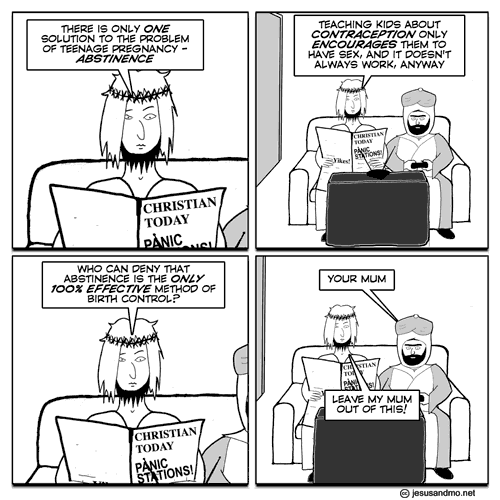
Birth Control

I was browsing the archives at Jesus and Mo and found this cartoon—laughed out loud.


Freedom of Expression

I’ve been reading the report, Freedom of Thought 2013 published by the International Humanist and Ethical Union:

Freedom of Thought 2013 is the first report to look at the rights and treatment of the non-religious in every country in the world. Specifically, it looks at how non-religious individuals—whether they call themselves atheists, or agnostics, or humanists, or freethinkers or are otherwise just simply not religious—are treated because of their lack of religion or absence of belief in a god. We focus on discrimination by state authorities; that is systemic, legal or official forms of discrimination and restrictions on freedom of thought, belief and expression.

[Read more…]

Do Goals Prevent Success?

Effectuative thinking, unlike causal thinking, is bottom-up. It doesn’t start with a final goal in mind. Instead, as Sarasvathy explains, “it begins with a given set of means and allows goals to emerge contingently over time.”

via Do Goals Prevent Success? – Study Hacks – Cal Newport.

This post touches upon a topic that I have written  about before here and here. Newport discusses the work of Saras Sarasvathy into entrepreneurship. The quick summary:

Sarasvathy identifies four main principles to approaching your work in this manner:

1. Start with what you already know how to do well.
2. Filter your efforts to avoid big downsides not to select for big upsides.
3. Work with other people who bring new abilities to the table.
4. Take advantage of the unexpected.

Religion, Freedom of Expression and Evidence

A couple of articles drew my attention recently: Religion Takes Offence Too Easily in the Urban Times and a short note on the debate in the House of Lords, International compliance with Article 18 of the Universal Declaration of Human Rights concerning freedom of belief.

From the Lords’ debate:

… Lord Singh of Wimbledon: ‘Religions do not help themselves by claims of exclusivity or superiority. This simply demeans other members of our one human race and suggests that they, the others, are lesser beings. We all know what happens in the school playground when one boy boasts—it is usually boys—that, “My dad is bigger or stronger or cleverer than your dad”. The end result is fisticuffs. My appeal to our different religions and the leaders of religion is to stop playing children’s games.’

From the Urban Times piece:

… offering my two cents. I wrote that therein lies the bane of religion. When confronted with fact, the religious deem it a mockery of their beliefs. They expect their irrational points of view to be treated with the same respect as all facts, neglecting the FACT that their claims have been proven unable to stand up to rational, realistic, or critical scrutiny. [On second thought, they demand that their points of view be treated better than facts, because you can make fun of facts, but you apparently can’t make fun of theological assertions.]

Both of these remarks seem to me to make entirely valid points. In the UK, society is certainly becoming more secular, and the suggestion that religion is needed to maintain morals and standards of behaviour is not acceptable. The argument that use of the scientific method and the requirement for evidence is some form of bullying is no less sound. I realise, of course, that not everyone will change their views despite overwhelming evidence—anthropogenic climate change, creationism/intelligent design, vaccination, the Decision Review System.

The real romance in the stars

Scientific truth is too beautiful to be sacrificed for the sake of light entertainment or money. Astrology is an aesthetic affront. It cheapens astronomy, like using Beethoven for commercial jingles. By existing law neither Beethoven nor nature can sue, but perhaps existing law could be changed. If the methods of astrologers were really shown to be valid it would be a fact of signal importance for science. Under such circumstances astrology should be taken seriously indeed. But if – as all indications agree – there is not a smidgen of validity in any of the things that astrologers so profitably do, this, too, should be taken seriously and not indulgently trivialised. We should learn to see the debauching of science for profit as a crime.

via The real romance in the stars – Voices – The Independent.

After yesterday’s post, I did some more web-wandering, and came across this 20-year old article by Richard Dawkins. Here’s another line that I like:

There are some stupid people out there, and they should be pitied not exploited.

I also discovered that Dawkins and I share the same birthday… which makes us both Aries.

Astrology-loving MP seeks health answers in the stars

BBC News – Astrology-loving MP seeks health answers in the stars.

I’m struggling to find words to express my opinion of this idiocy.

Christopher Hitchens: Religion Poisons Everything

Here’s a very good video of the late Christopher Hitchens’ talk and subsequent on-stage interview at the Festival of Dangerous Ideas in Sydney, 2009. It’s called Religions Poisons Everything and deals with the same topic as Hitchens’ book God Is Not Great that had been published a year or so earlier. It is a long video, but worthwhile viewing.

There’s a lovely “encore” right at the end (101:02) when Christopher sings the Pythons’ Bruces’ Philosophers Song.

[Read more…]

The Jiro Dreams of Sushi of Bread & Butter: Razza Pizza Artiginale

Delightful little film about a bread and butter nut.

via The Jiro Dreams of Sushi of Bread & Butter: Razza Pizza Artiginale on Vimeo.